

France woke on Sunday to the wreckage of one of its most violent days of unrest in years, after mass demonstrations over high prices and fraying public services descended into riots that left one protester dead and nearly 1,800 people in police custody.
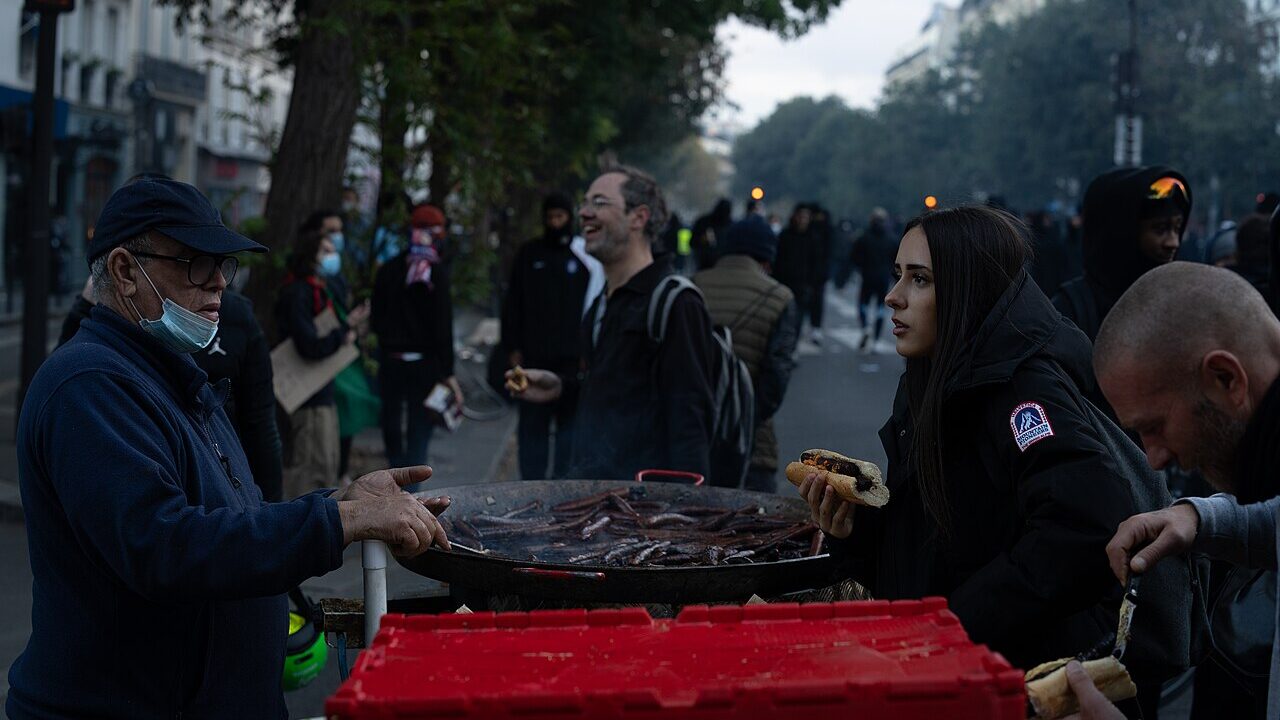
More than half a million people joined marches in scores of cities on Saturday, according to the interior ministry — the CGT union put the figure at 800,000. While hundreds of thousands protested peacefully, violent fringe groups clashed with police, looted luxury boutiques and supermarkets, and torched buildings. Police made a record 855 arrests in Paris alone, where one demonstrator died after suffering a cardiac arrest during the protests.
In Limoges, workers assessed the damage to the 143-year-old city hall, partially destroyed in an arson attack, while in Marseille protesters stormed the city hall and scrawled anarchist graffiti across its walls. In Bordeaux, a masked mob invaded the residence of the local prefect. President Emmanuel Macron posted late on Saturday that there was “no room for violence in our Republic,” vowing that those who had ransacked prefectures and town halls would be prosecuted and punished.
From School Gates to the Streets
The protests began last month in schools in the working-class northern suburbs of Paris, where students demonstrated over teacher shortages and crumbling facilities. The movement then broadened, drawing in unions and activists angry about inequality, public spending and the rising cost of living. Saturday marked the convergence of that month-long student movement with much wider social discontent, and the government blamed far-left groups for the worst of the violence. The unrest arrives just a day after American demonstrators fanned out across the United States for the No Kings vote-early push, a reminder that street politics is surging on both sides of the Atlantic.
A Test Before the 2027 Election
With the presidential election due in April 2027, the unrest has sharpened an already polarised contest. Recent polls point to a possible run-off between the National Rally’s Marine Le Pen and LFI’s Jean-Luc Mélenchon, and historians of French social movements warn that repeated refusals to compromise only deepen the desire to fight. With global crude prices already elevated on Middle East supply jitters, European markets will also be watching whether weeks of instability begin to feed through into energy and consumer confidence. A full international account of the aftermath carries the minute-by-minute details from Paris, Lyon and Marseille.