

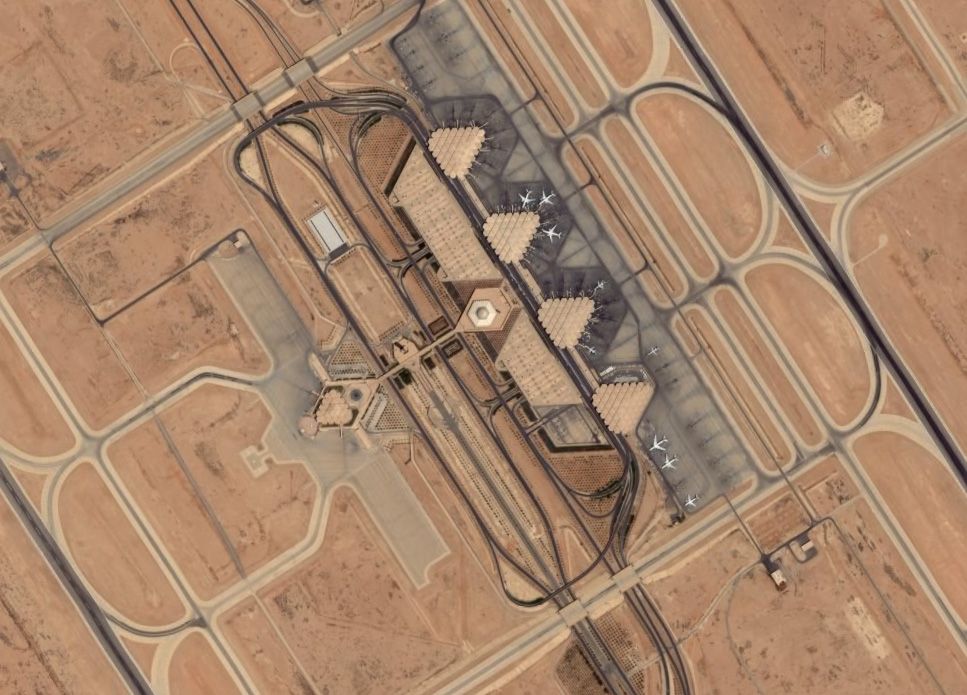
International airlines have suspended flights to Riyadh after attacks on Saudi airports killed three people and injured dozens, in an escalation that has disrupted one of the Middle East’s busiest aviation hubs.
According to reports, the Lufthansa Group said its airlines would pause Riyadh services through October 16, citing current developments in the region. In India, IndiGo cancelled Riyadh flights until October 9, while Air India and Akasa Air cancelled services until October 10. Air India said a Delhi-to-Riyadh flight returned to India on Thursday.
Yemen’s Houthi movement said it had struck King Khalid International Airport in Riyadh with a ballistic missile. Saudi authorities did not immediately confirm that specific claim. The distinction matters: a claimed missile launch, an intercepted weapon and a confirmed impact are different events, and officials had not publicly tied each claim to verified damage by Thursday evening.
Saudi Arabia’s aviation authority said attacks earlier in the week on Riyadh airport and Abha International Airport, in the country’s southwest, killed three people in total and wounded 36. Reports said one person died at the Riyadh airport and two at Abha, with the wounded including passengers and airport staff.
Smoke was seen rising from a stationary aircraft at Riyadh airport on Thursday, according to witness accounts cited in reporting. Flight-tracking data showed dozens of cancellations, and aviation analytics indicated that nearly half of scheduled departures from Riyadh had been cancelled by mid-afternoon. Those figures describe disruption, not a full closure, and schedules remained fluid.
The attacks mark a serious widening of risk. Riyadh is a political capital and a connecting hub; Abha lies closer to the Yemeni border and has been exposed during earlier rounds of fighting. That both airports were named by Saudi authorities in the same week suggests a threat no longer confined to border regions or military facilities.
The Houthis control large parts of western Yemen and have fought a Saudi-backed government for years. Fighting between the sides has intensified in recent days, according to reports, displacing civilians inside Yemen even as the conflict spills into international air travel. The Bab el-Mandeb Strait, a major shipping route, adds a wider economic dimension whenever the Yemen conflict escalates.
For airlines, the calculation is immediate. Carriers must weigh crew safety, insurance conditions, passenger connections and the possibility of airspace closures. A short suspension can ripple across networks because aircraft and crews end up out of position. Passengers in Riyadh faced cancellations, rebooking queues and uncertain onward travel.
There was no clear timetable for normal operations. Airlines set different return dates, and those dates could move again if threats continue. Saudi authorities said they were coordinating with security agencies to assess damage and keep civil aviation safe.
Saudi Arabia’s role as an aviation and energy hub raises the stakes of any repeat attack. Disruption at Riyadh affects pilgrim traffic, business travel and cargo connections across Asia and Europe, and airlines tend to restore services cautiously after security incidents involving civilian airports. Insurers and regulators will watch how Saudi authorities harden airport defences and how quickly carriers return. The Houthis, for their part, have shown an ability to sustain pressure beyond Yemen’s borders even after years of war. Unless the fighting inside Yemen eases, airlines planning winter schedules will have to treat Thursday’s cancellations not as an isolated shock, but as a scenario to price into routes across the Arabian Peninsula.
Related reading: Ukraine Counts Cost of Major Russian Strike as Winter Energy Fears Grow · Former UN Rights Chief Navi Pillay Wins 2026 Nobel Peace Prize · US Sanctions Two Mumbai Firms, Five Nationals Over Alleged Iranian Petroleum Trade