

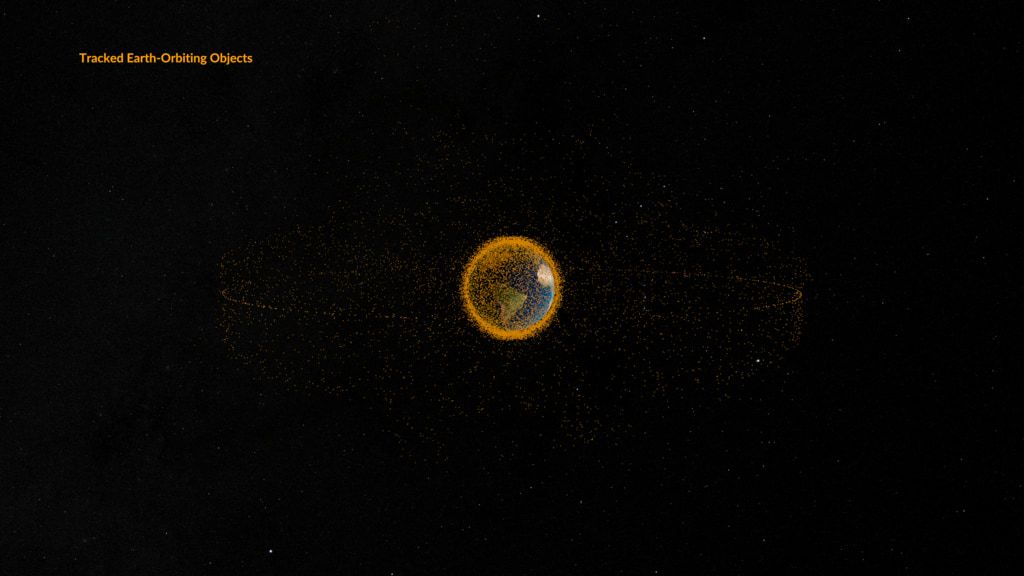
A weather satellite launched by the Soviet Union in May 1981 has broken apart in orbit, adding a fresh cloud of debris to one of the most crowded bands of space around Earth and renewing concern about how long dead hardware remains a hazard up there.
The satellite, Meteor 2-7, was part of the Soviet Meteor series of weather satellites, built to observe clouds and gather data on the atmosphere. It has been inactive for decades, circling the Earth at roughly 500 to 560 miles up, an altitude of about 800 to 900 kilometres where the atmosphere is too thin to drag objects down quickly. Debris at that height, NASA notes, can remain in orbit for decades or even centuries, depending on its size.
Orbital debris analyst Jim Shell narrowed the breakup to about 09:45 UTC on October 5, give or take ten minutes, using orbital data from US Space Forces — Space, distributed through Space-track.org. Shell observed that the satellite’s altitude sits in a dense region for orbital debris, and that the estimated breakup time placed the inclined satellite near its highest latitude, where the spatial density of debris is greatest. Whether it was struck there, he said, will likely never be known.
Two broad explanations are on the table. The satellite may have suffered an internal failure, the kind of battery or pressure-vessel event that has torn apart ageing spacecraft before. Or it may have collided with another object, quite possibly one too small to be tracked, in which case the first anyone learns of the other object is the damage it did.
The company that flagged the event described it as part of a worrying trend for space safety and security, and the arithmetic explains the worry. Every breakup converts one large, trackable, predictable object into many smaller ones, some of them too small to catalogue but still fast enough to damage a working satellite. Operators then have to manoeuvre around a debris field whose contents can only be partly seen.
Low Earth orbit is carrying more traffic than at any point in history: mega-constellations of communications satellites, crewed stations, weather and imaging fleets, and the accumulated hardware of six decades of launches, much of it abandoned. Breakups of legacy satellites are a reminder that the debris problem is not only about what humanity launches next, but about what it left up there before disposal rules existed.
Tracking networks will now catalogue what they can of the Meteor 2-7 cloud and fold it into the warnings issued to satellite operators. The satellite itself survived the Cold War that built it by three and a half decades. Its fragments, at 855 kilometres, may outlast everything currently on the launch pads.
What happens next is methodical rather than dramatic. Analysts will observe the new fragment cloud over the coming weeks as it spreads along Meteor 2-7’s orbit, assign catalogue numbers to the pieces large enough to track, and estimate how many smaller pieces accompany them. Satellite operators along that orbital band will add the fragments to their conjunction screening, the automated process that warns when debris is predicted to pass close to a working spacecraft. Each warning costs operators time, fuel or both. A satellite that stopped working decades before most of today’s engineers were born will be taxing their attention for years.
Related reading: NASA to Brief on Its Role in Japan's Mission to Land on a Martian Moon · Four Astronauts Return to Earth After 237 Days in Space · NASA Releases 800 Gigabytes of Artemis II Moon Data for Researchers