

Margaret Hamilton, the computer scientist who led development of the flight software that guided Apollo astronauts to the Moon and who popularised the term software engineering, has died at the age of 90.
The Massachusetts Institute of Technology said Hamilton died on September 30 in Cambridge, Massachusetts. NASA’s administrator paid tribute on social media, calling her a pioneer whose work helped make humanity’s first journeys to the Moon possible. She had lived long enough to see her once-overlooked role become one of the most famous stories in computing.
Born Margaret Heafield in Paoli, Indiana, in 1936, she studied mathematics at Earlham College and moved to Boston in 1959. She worked at MIT first on weather systems and early air-defence computing, then joined the laboratory building software for NASA’s plan to send people to the Moon. MIT described her as the Apollo project’s first programmer at the laboratory and, by 1968, the leader of a large team responsible for command and lunar module software.
The work was unforgiving. Apollo’s guidance computer had tiny memory by modern standards and no room for casual failure. Hamilton championed priority-driven, error-handling design: software should recognise overload, shed less important work and protect the tasks needed to land. During Apollo 11’s descent, warning alarms appeared as the computer became overloaded. Because the software prioritised correctly and controllers understood the alarms, the landing continued.
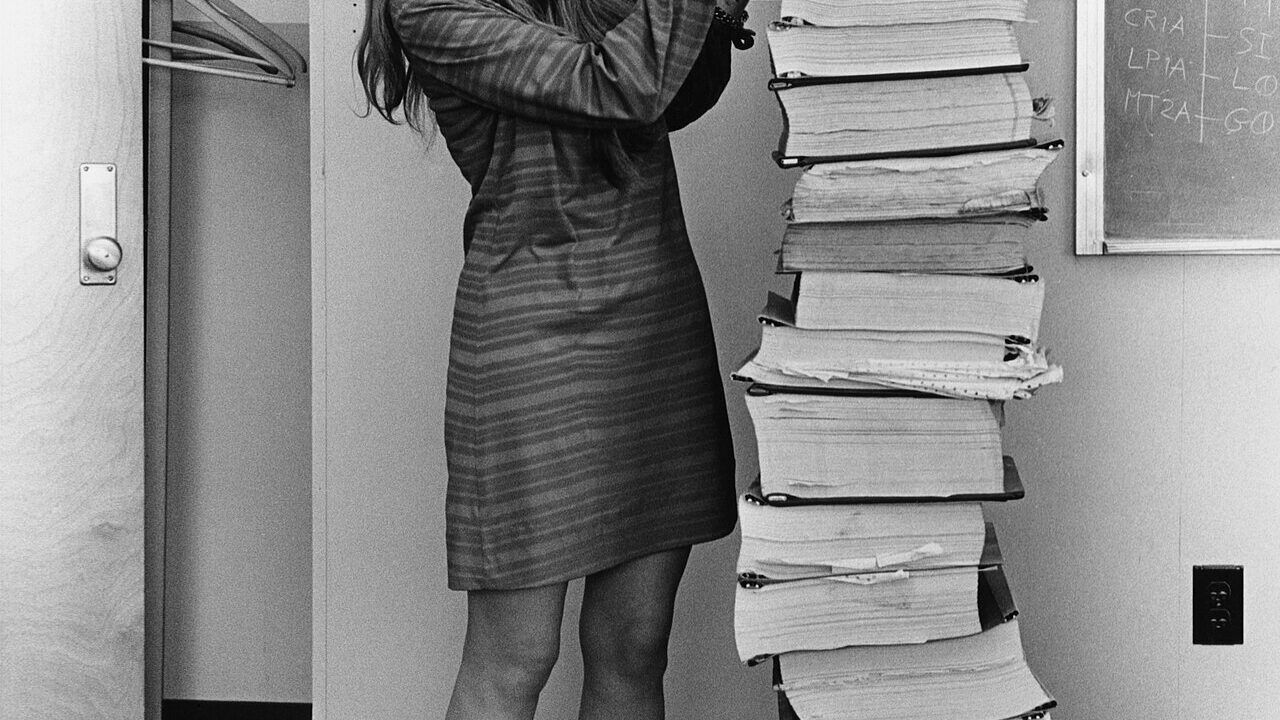
A famous photograph shows Hamilton standing beside a stack of printed Apollo code as tall as she was. The image became a symbol not just of one mission, but of the invisible labour behind spaceflight. Rockets are photographed at launch. Software is noticed mainly when it fails. Hamilton’s career helped reverse that hierarchy.
She used the term software engineering deliberately. At a time when programming was often treated as an afterthought to hardware, she argued that building reliable software required the discipline of an engineering field. The phrase now names university departments, job titles and an entire professional culture.
After Apollo, Hamilton founded two software companies in Cambridge and published extensively on systems design. She received NASA’s Exceptional Space Act Award in 2003 and the Presidential Medal of Freedom from President Barack Obama in 2016.
Her death comes as NASA prepares a new generation of lunar missions. The computers are vastly more powerful, but the lesson of Hamilton’s work has not aged: complex machines are only as trustworthy as the people who imagine their failures in advance.
Hamilton’s influence reaches far beyond Apollo. Every modern aircraft, hospital system and banking network depends on software that must not fail when conditions turn abnormal. Her insistence that such software be engineered, tested against imagined disasters and given status equal to hardware is now standard practice in safety-critical industries. She also changed the image of who builds these systems: generations of engineers first met software through the photograph of a woman standing beside the code that landed on the Moon. As Artemis prepares to send crews back, Hamilton’s standard remains the benchmark. The software must work on the day when everything else goes wrong.
Recognition came late but completely. Universities teach her Apollo work in introductory courses, her name appears in children’s books about women in science, and the photograph beside the code stack has been reproduced on posters in classrooms worldwide. Hamilton herself remained focused on method to the end of her career, developing formal approaches intended to catch errors before systems are built rather than after they fail. That lifelong argument, that prevention is engineering, is her second legacy alongside Apollo. She was 90, and the field she named now employs millions. Few of them will ever write code on which lives depend within minutes. She did, and it worked.
Related reading: NASA Shares Curiosity Dawn View of Wind-Carved Cliffs on Mount Sharp · Henri Kagan and Kenso Soai Win 2026 Nobel Prize in Chemistry for Mirror-Image Molecule Work