

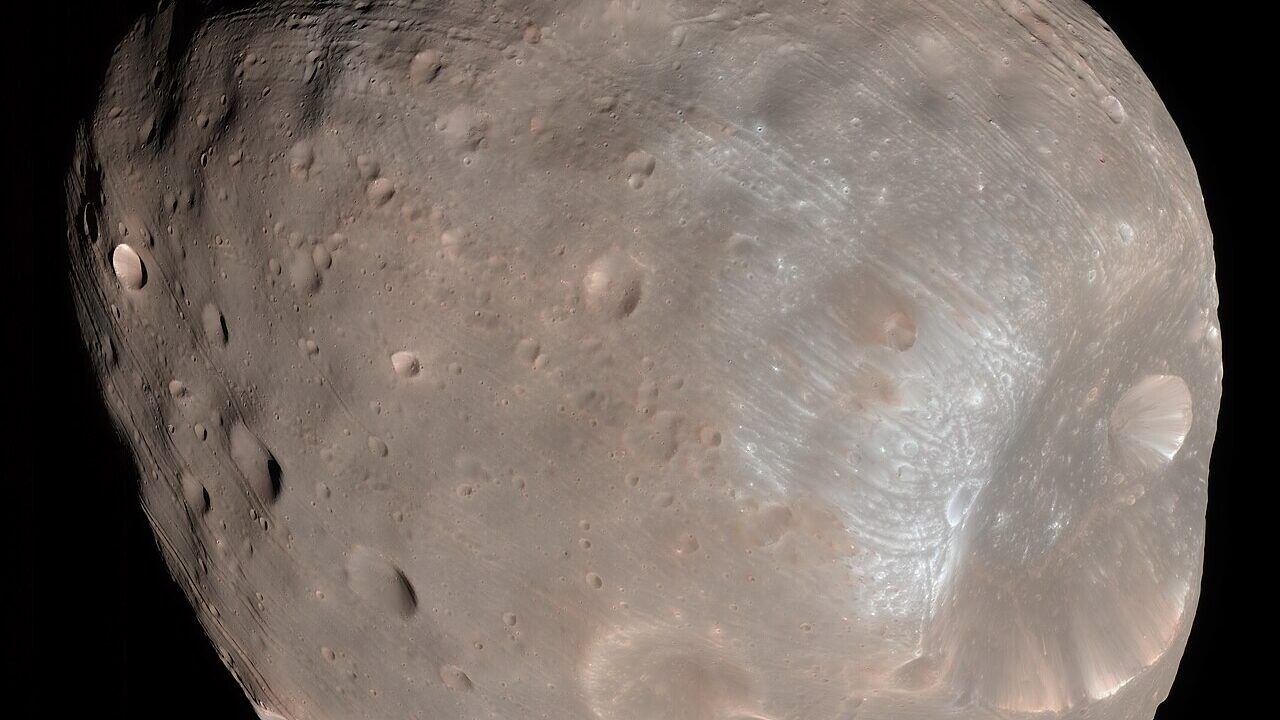
NASA will brief the media next week on its contributions to Japan’s Martian Moons eXploration mission, an ambitious attempt to land on the surface of Mars’s larger moon, collect a sample of it, and bring that sample back to Earth.
The media teleconference is set for 4 p.m. Eastern on Thursday, October 15, ahead of the mission’s launch from JAXA’s Tanegashima Space Center in Japan on Monday, October 19 Eastern time. Audio of the briefing will stream on NASA’s website. The spacecraft is expected to arrive at Mars in August 2027 to begin its survey of the planet’s two moons, Phobos and Deimos.
After surveying Phobos in detail, the spacecraft will collect a sample of the moon’s surface no earlier than December 2028 and deliver it to Earth in 2031. That would make it the first sample ever returned from the Martian system, arriving before any mission brings back material from the surface of Mars itself.
NASA’s contributions are built around one instrument and one machine. The MEGANE spectrometer, developed by the Johns Hopkins Applied Physics Laboratory, will measure gamma rays and neutrons coming from the moons to work out what they are made of. The spacecraft’s pneumatic sampler, the mechanism that will actually gather material from Phobos, was developed by Honeybee Robotics, a Blue Origin company. NASA is also providing communications and navigation support through its Deep Space Network and funding American scientists on the mission’s science team.
Participants in the briefing will include Lindsay Hays, acting director of NASA’s Planetary Science Division; Tom Statler, the mission’s NASA programme executive and scientist; David Lawrence, who leads the MEGANE instrument team; and Kris Zacny of Honeybee Robotics.
The science question at the centre of the mission is an old one. Phobos and Deimos are small, dark and irregular, and planetary scientists have argued for decades over whether they are asteroids captured by Mars’s gravity or fragments of Mars itself, blasted into orbit by an ancient impact. A sample in a terrestrial laboratory, measured with instruments far more sensitive than anything that can fly, should settle the argument and, with it, part of the story of how the inner planets were assembled.
The mission is funded on the NASA side through the agency’s Discovery Program, which flies focused planetary science missions at a faster cadence than the flagship programme, and is managed for NASA by the Marshall Space Flight Center in Huntsville, Alabama. A small spacecraft built by Japan, carrying an American spectrometer and a sampler built by a private American company, is about to attempt one of the most delicate landings in the solar system. The briefing next week is where its team explains how.
The instrument names carry the mission’s logic. MEGANE, pronounced “megane,” is short for Mars-moon Exploration with Gamma-rays and Neutrons, and its measurements of the radiation coming off Phobos and Deimos will reveal their elemental composition, a fingerprint that differs depending on whether the moons are captured asteroids or shards of Mars. The pneumatic sampler tackles the other half of the problem: in Phobos’s feeble gravity, a conventional drill or scoop could push the spacecraft away, so the sampler uses gas to blow surface grains into a collection chamber. Getting there is only half the mission. The briefing on October 15 is where the team walks through how it intends to come back.
Related reading: Soviet-Era Weather Satellite Breaks Up, Adding Debris to Crowded Orbit · Four Astronauts Return to Earth After 237 Days in Space · NASA Releases 800 Gigabytes of Artemis II Moon Data for Researchers